Thursday, August 2, 2012

Nvidia Binary Exploit Gives Root Access on Linux


Nvidia is reported to have a dangerous exploit in its binary driver and it seems that is doing nothing to fix the situation or even acknowledge it.

In a mailing list post, Dave Airlie, a well known X hacker, has reported that a bug in the Nvidia binary would grant a user root access. He says the information has been passed to him anonymously, but the source is to be trusted.

It basically abuses the fact that the /dev/nvidia0 device accept changes to the VGA window and moves the window around until it can read/write to somewhere useful in physical RAM, then it just does an priv escalation by writing directly to kernel memory.” - said Dave Airlie.

Nvidia has some problems with its drivers before, and even recently, Linus Thorvalds gave them the finger, literally. This is not good news for the video card manufacturer. The only way out of this is to provide a fix as quickly as possible.

Upcoming Features of Fedora 18


Now that we know the codename for the upcoming Fedora 18 operating system, and the fact that it will introduce support for 256-color terminals, it is time to learn something about other features that will be incorporated in this anticipated release.

On the Fedora Engineering Steering Committee (FESCo) meeting that took place two days ago, on July 30th, the developers approved several new features for the Fedora 18 release:

· Samba 4.0;
· MATE desktop environment;
· oVirt engine 3.1;
· Agent-Free Systems Management;
· Sugar 0.98;
· LTTng 2.0;
· ownCloud;
· support for Google Cloud Printing;
· support for HP ePrint;
· support for network IPP servers;
· SELinux Systemd Access Control;
· IPA v3 trusts update;
· Python 3.3;
· FedFS (Federated File System);
· Server KMS drivers;
· LLVM support on 64-bit POWER systems;
· Systemtap 2.0;
· NFSometer;
· VNCServer support for LLVMpipe/Mesa on 64-bit IBM Power Systems;
· QXL/Spice KMS driver.

Wednesday, August 1, 2012

Install Android 4.1 Jelly Bean Theme For Ubuntu 12.04/Linux Mint 13


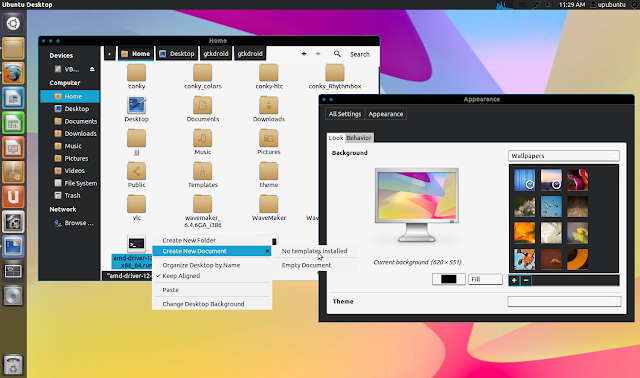
GtkDroid is a new GTK3 theme inspired by the new Android 4.1 Jelly Bean OS. The theme is compatible with both Unity and Gnome Shell. In this tutorial we will help you install it under Ubuntu 12.10/12.04/11.10 and Linux Mint 13 or older. Here is a screenshot of GtkDroid under Ubuntu 12.04 (Precise Pangolin):


GtkDroid Installation

The theme is available in two different styles (dark & light), you can install them all with these commands:

sudo add-apt-repository ppa:upubuntu-com/gtk3
sudo apt-get update
sudo apt-get install gtkdroid

To enable the default style, run these commands:

gsettings set org.gnome.desktop.interface gtk-theme 'Jellybean-GTK'


gconftool-2 --set --type string /apps/metacity/general/theme 'Jellybean-GTK'

To enable the light version of GtkDroid, run these commands:

gsettings set org.gnome.desktop.interface gtk-theme 'Jellybean-GTK-Light'


gconftool-2 --set --type string /apps/metacity/general/theme 'Jellybean-GTK-Light'

Note: Icon theme used with GtkDroid is Faenza.

Theme Home Page

How to permanently disable menubar in Gnome Terminal


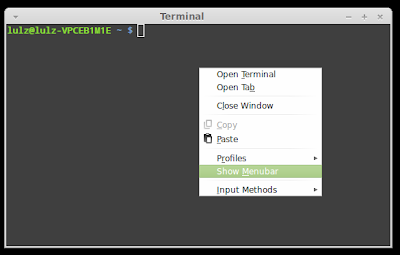
Normally, when you right click on the Gnome terminal, there will be the option to turn on/ off the Menubar. When you click on this option, the menubar in the Gnome terminal will disappear.


However, if you close this terminal and start another one, the menubar will appear again and you will have to turn it off once more.

In this article, I will show you how to permanently disable this menubar.

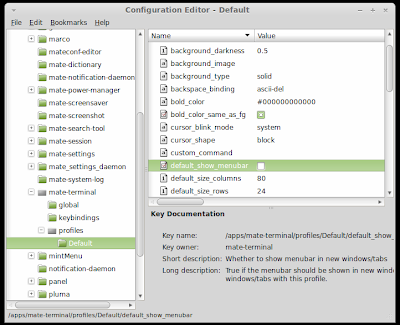
If you use Linux Mint MATE, just hit Alt + F2 then type "mateconf-editor" to open the configuration window. After that, go to apps > mate-terminal > profiles > Default then uncheck the "default_show_menubar" option and everything is done:


If you are using Ubuntu or Linux Mint Cinnamon, you will have to install gconf-editor first, just open the terminal and run the following command:
sudo apt-get install gconf-editor

After that, hit Alt + F2 and typ "gconf-editor" to open the Configuration Editor window and go to apps > gnome-terminal > profiles > Default and uncheck the "default_show_menubar" just like what you would do in MATE. And next time you open the Gnome terminal, you wont see the menubar again.

Kickstarter Indie Bundle Brings Games to Linux


The Kickstarter initiative has helped a lot of developers to find funding for their projects, and now, a group of indie game developers are asking for the help of the community once again.

The developers have gathered in a project called Kickstarter Indie Bundle. They are asking for money to develop a total of nine game, but only four of those will make it to Linux.

The first game is Metagolf, a platform action game for 1 to 4 players. It’s like Mini-Golf but crazier since everyone is playing at the same time with the same golf ball.

The second game is called Ensign-1, a space combat game that aims to give the player limitless freedom. You aren't limited to merely piloting a single fighter throughout the course of battle. You can dock and board frigates, capital ships, and even asteroid bases.

The third game is Christmas Magic, a unique combination of a story book and a game for the whole family or for short breaks from work.

The forth and last one is TRI (only possible for Linux, I'm not sure the developers will have the money to port it). The game is a freeform 3D platformer with environmental puzzles inspired by games like Portal, Thief, and Zelda.

You can find more details about the game on the official Kickstarter website.

KDE Software Compilation 4.9 Officially Released


After six month of hard work, the KDE Software Compilation 4.9 is finally here, as announced by KDE e.V. and the developers behind the KDE project a few minutes ago, August 1st.

KDE Software Compilation 4.9 brings beautiful new features, lots of performance improvements, as well as various software updates.

Highlights of KDE Software Compilation 4.9:

• Improved Dolphin file manager with back/forward buttons and in-line file renaming;
• Improve Konsole terminal app with text selection using KDE Web Shortcuts;
• Improved KWin window manager;
• Deep integration of Activities throughout the Workspaces;
• Okular can now store and print annotations with PDF documents;
• Improved bookmarking, search, and text selection in Okular ;
• Added Last.fm support in Juk (includes scrobbling, cover-fetching and MPRIS2 support);
• Added support to group all off-line users in Kopete;
• Improved Kontact;
• Added Pairs, a new memory game;
• Added Rocs, a graph theory app;
• Improved Kstars;
• Upgraded KDE Games;
• Qt Quick improvements;
• Faster access of network shares (including NFS, SSHFS and Samba);
• Faster desktop search by fixed many annoying bugs in Soprano and Nepomuk;
• Stability and performance improvements.

For more details, please check the official announcement for KDE Software Compilation 4.9. Also, check out the screenshots attached below!


 Download KDE Software Compilation 4.9.0